If you are looking at your child and wondering whether the phone, game or social media has started to take over, this page is for that moment.
Nothing about this is simple. The same device may hold homework, friends, music, a camera, games and an endless feed. Taking it away can feel like taking away half your child's social life. Leaving it alone can feel irresponsible. Both reactions make sense.
The aim is not to make children frightened of technology. It is to help them use it without losing sleep, safety, relationships or the parts of childhood that need time away from a screen.
Do these three things first
- Charge phones and tablets outside the bedroom. Start with the adults' devices too. Protecting sleep is the clearest place to begin.
- Ask your child to show you what they do online. Start with what they enjoy. Then ask whether anything there has made them worried, ashamed or uncomfortable.
- Tell them they can come to you without being punished. This matters especially if anyone ever threatens them with a private image.
How can I tell whether there is a real problem?
The number of hours cannot answer that question by itself. Two hours making a film with friends is not the same as two hours scrolling alone at midnight.
Look at what is happening around the screen use:
What are they doing?
Talking to friends, creating and learning are different from endless feeds, gambling-like games or sexual content.
What is it replacing?
Look for lost sleep, missed school, less movement, abandoned interests or withdrawing from family and friends.
Can they stop?
Pay attention if they keep using it after deciding to stop, hide what they are doing or become extremely distressed when access ends.
How do they feel afterwards?
Relaxed and connected is different from agitated, ashamed, frightened or unable to settle.
A difficult evening does not prove that your child is addicted. A pattern of lost control and harm deserves attention even if the total number of hours does not look extreme. Read the signs that screen use may have become compulsive if this is what you are seeing.
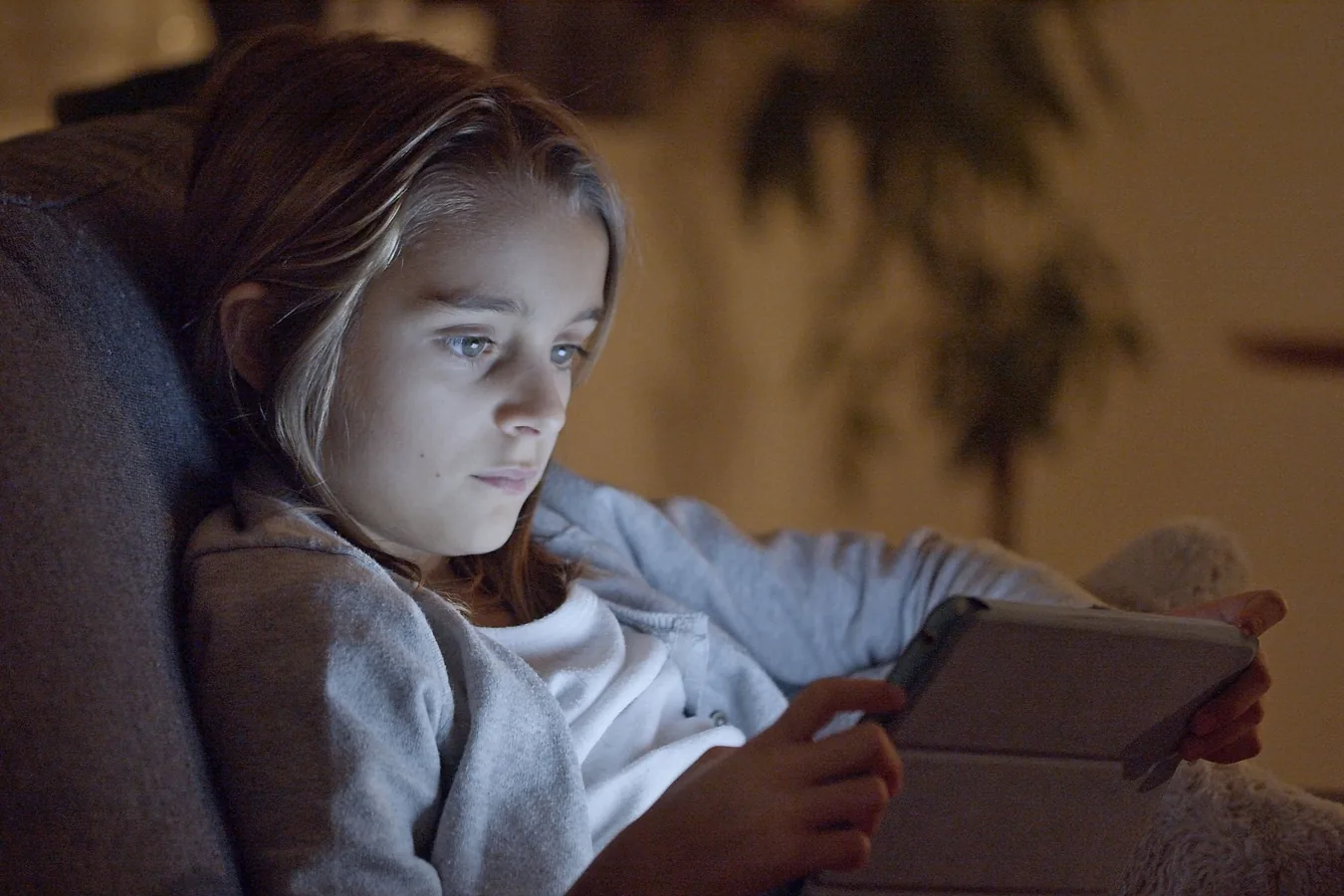
What can we change at home?
Protect sleep first
The American Academy of Pediatrics recommends keeping devices out of bedrooms, avoiding screens for the hour before bed and using Do Not Disturb overnight. Make one charging place outside the bedrooms and use it as a family.
Make the rules together
Decide where screens live, when they are put away and what still needs to be available for school or safety. Children are more likely to tell you what is really happening when the conversation is not only about punishment. The AAP's Family Media Plan is a useful free starting point.
Do not rush the first smartphone
A child can call you without carrying social media, a browser and an endless feed. A basic phone or watch may be enough. Read the first-phone guide before choosing the device.
Watch or play with them sometimes
Ask them to show you the game, creator or group chat they care about. You will learn more in twenty curious minutes beside them than in an argument from across the room.
Let them see you put your own phone away
If the rule is no phones at dinner or overnight, it needs to include the adults. This is not about being a perfect example. It is about making the change together.
Three risks every parent should understand
Sleep
Digital media use is consistently associated with later bedtimes, shorter sleep and poorer sleep. That does not mean every tired child is tired because of a phone, or that every study proves cause and effect. It does mean that removing the device from the bedroom is a sensible, low-risk change. The current AAP technical report explains the evidence and its limits.
Sextortion
Sextortion is when someone gets, creates or claims to have a sexual image and uses it to demand money or more images. Teenage boys are often targeted for money. NCMEC received more than 50,000 reports of financially motivated sextortion in 2025—an average of 137 a day.
Say this before anything happens:
If this is happening now, do not blame your child and do not pay without first getting help. Save the evidence and use the steps on the sextortion emergency page. You can also go directly to NCMEC's CyberTipline or its free Take It Down service. NCMEC's latest figures and advice are here.
AI companions
An AI companion is a chatbot designed to behave like a friend, partner or confidant. It is different from using AI to answer a homework question. In a 2025 national survey, 72% of American teenagers said they had tried an AI companion. Common Sense Media recommends that under-18s do not use them.
If your child is already talking to one, begin by asking what it gives them and listening to the answer. Then read what parents need to know about AI companions. A calm conversation gives you more information than a sudden interrogation.
How do I talk to my child without starting another fight?
Begin with their experience, not your verdict.
You could say: “I know your phone is not just entertainment. Your friends, school and a lot of your life are on it. I am not trying to take your life away. I am worried about what it may be doing to your sleep and how hard it can be to stop. Can you show me what it is like for you?”
Listen to the full answer. You can still set a boundary afterwards. Understanding your child does not mean handing the decision to them. It means making the decision with better information and keeping the relationship open enough that they will come back if something goes wrong.
What does the research actually say?
The most accurate answer is not “screens are harmless” or “screens are ruining every child.” Different children use different technology in different situations, and most of the research is observational. It can show a relationship between two things without proving that one caused the other.
The American Academy of Pediatrics now asks families to look beyond a single screen-time number. Its 2026 guidance considers the child, the content, the design of the product, the family and what digital media may be pushing out of the day. It also recognises that good digital media can support learning and connection.
That uncertainty is not a reason to do nothing. Protecting sleep, keeping communication open, delaying products a child is not ready for and responding quickly to a safety threat are reasonable steps even while researchers continue to debate the size and causes of wider mental-health effects.
Why do experts disagree about smartphones and mental health?
Some researchers believe the move to a phone-based childhood is an important cause of rising anxiety and depression. Others argue that much of the evidence is correlational and that family life, school pressure, inequality and many other changes also matter. The dispute is real. It does not cancel the clearer evidence about sleep, unsafe contact, exploitative design and compulsive use. The AAP's 2026 policy statement is a careful overview of what is known and what is still uncertain.
When should we get more help?
Get outside help if your child is losing sleep night after night, missing school, giving up nearly everything else, lying or hiding use, spending money secretly, being threatened online, or repeatedly trying and failing to stop.
Start with your child's doctor or a qualified child mental-health professional. If the problem involves gaming, social media or other compulsive technology use, the help directory also lists free peer-support meetings and specialist routes. If there is immediate danger, contact your local emergency service.
Choose the help you need next

Michael has spent much of his working life online—and much of the rest of it trying to stop that technology taking over. He has thrown a phone into a lake, locked devices in boxes and experimented with long periods offline. He writes about what helped, what failed and how to keep the useful parts of digital life.
Last updated 11 August 2026. Research and safety guidance are linked to their original sources. If you spot something out of date or wrong, tell me and I will fix it.