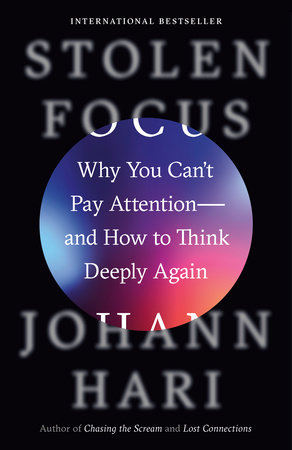
Stolen Focus was published in January 2022 and became a bestseller on an argument that is easy to state and hard to accept: that the collapse of your attention is not your fault. Johann Hari names twelve causes, and only some of them are screens. The book has also been challenged, seriously, on whether its central claim can be evidenced at all. Both halves of that are worth knowing — before you read it, or instead of reading it.
American college students now hold their attention on a single task for about 65 seconds
The figure that travels furthest from this book is the one about students. Watch what an American college student actually does at a desk, and the average time spent on one task before switching is around sixty-five seconds. For office workers the figure is roughly three minutes.
Sixty-five seconds is not long enough to read a page, follow an argument, or have a thought that goes anywhere. And the switching is not free — Hari’s account of the research is that moving between tasks costs something every time, in accuracy and in the time it takes to get back to where you were. A day made of three-minute fragments is not the same day’s work done in a different order. It is less work, done worse, by someone who ends the day more tired.
What makes the number land is that almost nobody chose it. Very few people decided to work in ninety-second pieces. The environment decided, and the person inside it experiences the result as a personal failing — a discipline problem, something to fix with an app or an early night.
That gap between what caused the problem and where the blame lands is the subject of the whole book.
Hari’s central move is to take the blame off the individual and put it on the system
There are two explanations available for why you cannot concentrate. The first is that you are undisciplined. The second is that a set of powerful forces has been working on your attention for two decades, several of them designed by people paid well to do exactly that.
Almost all the popular writing on this subject picks the first explanation and then sells a solution: a planner, a technique, a morning routine. Hari picks the second, and the consequences are awkward, because if the causes are structural then the fixes have to be too. You cannot out-discipline a business model.
He is explicit that individual effort is not enough. Workplaces expect instant replies. Notifications are engineered by teams. Both are conditions you live inside rather than choices you make each morning, and telling someone to try harder inside those conditions is close to useless.
His conclusion is therefore political rather than personal. He argues attention should be treated as a public health question, the way air quality is, and calls for what he names an “attention rebellion” — collective pressure rather than private willpower. That will read as either obvious or overreaching depending on your politics, and it is the part most likely to irritate someone who came for practical advice.
Four of his twelve causes have nothing to do with screens, which is the book’s most useful surprise
The twelve causes are not twelve ways your phone is bad. They include the increase in speed, switching and filtering; the crippling of flow states; the disruption of mind-wandering; the rise of technology built to track and manipulate; the surge in stress and the vigilance it produces; and what he calls cruel optimism.
Then it widens considerably. He gives chapters to the deterioration of diets, the rise of pollution, the rise of ADHD and how we respond to it, and the physical and psychological confinement of children.
Those four have nothing to do with a smartphone. A child never allowed to play unsupervised outdoors is losing something no screen-time limit gives back. Air quality and food are not attention topics in ordinary conversation, and putting them in the same list as social media is the most interesting decision in the book.
It is also the most contestable. Assembling twelve causes of different kinds and different evidential strength into one list gives each of them the same apparent weight, and they do not have it. Reviewing the book for The Irish Times, Karlin Lillington praised Hari for making academic research accessible while noting that he sometimes goes too far in reducing complex topics to bullet points. That is a fair description of this structure.
The widening is still worth having, because it breaks the assumption that attention is a technology problem with a technology solution.
Three months on a flip phone in Provincetown gave him his focus back, then complicated the story
Hari took himself to a beach house in Provincetown, Massachusetts, swapped his smartphone for a flip phone with no internet, and navigated with a printed road map.
The first stretch was unpleasant. He describes agitation at not being able to reach the internet — the specific discomfort of a reflex with nowhere to go.
Then it settled, and kept settling. The longer he stayed off, the more easily his mind cleared and held one thing. He read. He thought. He reports that letting his mind wander produced ideas he would not otherwise have had.
The honest complication is the part most people skip when they cite this book approvingly. The retreat worked while he was in it. It was a beach house, three months, no job demanding instant replies, no children. Almost nobody reading the book can do that, and Hari knows it — he does not present it as a solution, and it would be a misreading to take it as one.
What it is instead is a demonstration that the capacity is still there. The attention was not destroyed; it was occupied. Remove the occupation for long enough and it comes back, which is a genuinely hopeful finding and also an argument for changing the conditions rather than periodically fleeing them.
Mind-wandering is not the failure of attention; it is the condition under which good thinking happens
Most advice on focus treats the wandering mind as the enemy — the thing to be noticed and returned from.
Hari argues close to the opposite. Mind-wandering is where connections get made between things you already know, where problems get solved sideways while you are not looking at them, and where anything resembling an original thought tends to arrive. A mind kept permanently on task never does this. Neither does a mind that fills every gap with a feed.
This reframes what a phone actually takes. The obvious cost is the time spent on it. The subtler cost is the elimination of every interval in which nothing was happening — the queue, the walk, the wait, the few minutes before sleep. Those intervals were not empty. They were doing something, and nobody noticed until they were filled.
It is also the most practical idea in the book, though Hari does not present it as a technique. If wandering is productive rather than wasteful, then boredom is not a gap to be closed, and the right response to a queue is nothing at all.
The central claim has been seriously challenged, and the book is still worth your time
Here is the part a summary should not leave out.
The psychologist Stuart Ritchie has questioned whether there is good scientific evidence for the book’s central thesis — that people’s ability to focus has actually declined over time. The criticism was set out by Hugh Linehan in The Irish Times in January 2022. It is not a quibble about a statistic. It goes at the foundation: we do not have the long-running measurements that would prove attention is worse now than in 1990, because nobody was taking them. The Sydney Morning Herald added, more mildly, that much of the research had been covered elsewhere first.
So what survives?
The mechanisms survive. That switching costs something, that flow states are fragile, that platforms are engineered to maximise engagement and collect data, that children have less unsupervised play than they did — these are documented independently of whether a population-level decline can be proven.
The reframing survives too, and it is the reason to read the book. Whether or not average attention has measurably fallen, the question why am I like this? produces a better answer when it is asked about the environment than about the person. People who believe their distraction is a character flaw tend to respond with self-criticism, which is both unpleasant and ineffective. People who can see the machinery tend to respond by changing something.
That is not a small thing to get from a book, and it does not depend on the contested claim being true.
Read it, or skip it
Read it if you want to understand why this is happening rather than be handed a routine. Skip it if what you want is a plan for next week — for that, start with Cal Newport’s Digital Minimalism, which is on the reading list.
Sources: Stolen Focus, Johann Hari, Crown/Bloomsbury, 25 January 2022 · Hugh Linehan, ‘Too few of us are paying attention to the problems with Johann Hari’s new book’, The Irish Times, 15 January 2022 · Karlin Lillington, The Irish Times · Jenna Price, The Sydney Morning Herald, 14 April 2022.
The full reading list Do a digital detox

Michael has spent much of his working life online—and much of the rest of it trying to stop that technology taking over. He has thrown a phone into a lake, locked devices in boxes and experimented with long periods offline. He writes about what helped, what failed and how to keep the useful parts of digital life.