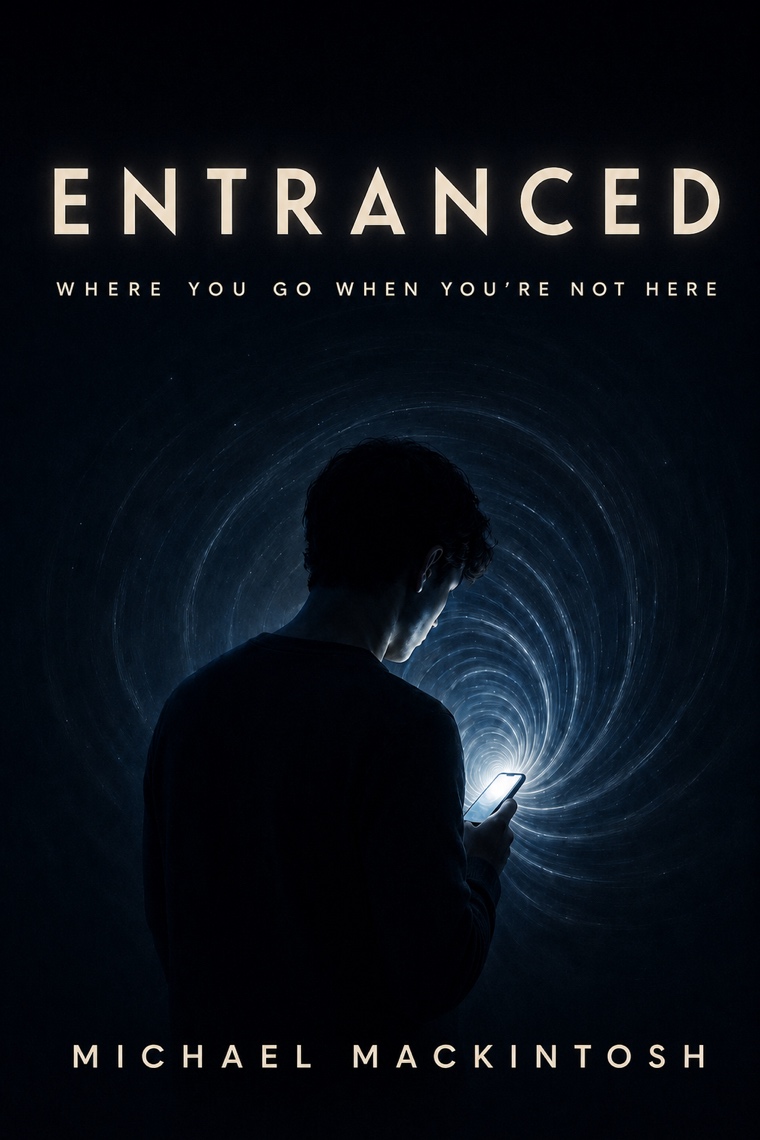
Cover of Entranced by Michael Mackintosh

Literary excerpts

Scenes From Entranced

Five personal stories and literary comparisons from Michael's book about life inside screens and systems that compete for attention.

These literary excerpts are stories, not advice.

Read the complete book or choose a shorter sample →

Kauai · April 2025

Before I Even Posted Anything

I arrived on the island determined to create some content that would inspire people and promote my work on Instagram. I had a month to do it.

Under normal conditions, I refuse to touch Instagram with a long stick. But I decided if I was to use this app, I should download it and start scrolling so at least I could see what other content is out there.

It was a science project. A research mission.

Within the first few seconds I felt both shocked, awed and hooked.

Within an hour, I felt overwhelmed, insecure and needy. I saw how much better other creators were doing than me. At a certain point I stopped ignoring the ads and started clicking on them.

All ads about how to make viral content. The secret to get rich on Instagram. How I got 250K followers in a month and how you can too.

I was already altered by that point. The trance had settled in nicely. I bought one course, then another, then another.

They all said the same thing. Please the algorithm. Find out what others are doing and copy them. Use clever hooks. Reward people in the first three seconds or less.

I went from curiosity to a feeling of lack and prostituting myself to the lords of the algorithm. Without knowing it I was starting to learn how to create the exact variable rewards loonie loop content that got me trapped. Because that's what is rewarded.

I felt fundamentally off kilter, as if I was standing on one leg carrying a large box of bananas.

And that's before I even posted anything.

A client's story · identifying details changed

Best Friends

When they arrived, it started immediately.

They walked through my door with a Nintendo Switch and three phones. They were close friends we had not seen in more than two years. Within twenty minutes, one of them had started work calls. On a Saturday afternoon. In our house. She did not even close the door.

My husband took his friend out for a walk. He had been waiting for this. His friend had his phone out the whole time, checking it constantly, not listening.

At one point my husband suggested somewhere to get a drink. We have lived here for years. He knows every place. His friend held up a finger, opened ChatGPT, and typed the question in.

“It is easier this way,” he said. “Where is a good place to get a drink around here?”

He teaches executives how to be present for a living. He charges them for it.

Their daughter was eight. She had been tested for ADD. I watched her pick up a toy, hold it for two minutes, put it down. Next one. Three minutes. Next. Two minutes. She was in a room full of toys with a child she had not seen in over a year and she said she was bored.

We finally all went for a walk. It was the thing we had planned. Within minutes, one of the adults was on the phone to somebody else, planning a birthday party and ignoring us.

Then the Nintendo Switch came out.

My son came running out of the room screaming so hard he could not get the words out. His face was red and twisted and wet. He threw himself at me, fists balled, sobbing, trying to speak between gasps. His whole body was shaking. The other child appeared in the doorway behind him, holding the device with both hands, eyes flat.

I took it and put it in the closet.

It got worse. Crying. Screaming. My son on the floor pounding it with his fists. The other child kicking the wall. Two children who had not seen each other in over a year, in a house full of toys, on a beautiful afternoon. Shaking and wailing over a screen.

Eventually they calmed down. Eventually they played together.

Then came dinner. And the FaceTime. And the Apple Watch. And the scrolling. And the eight-year-old texting someone none of us knew while a child on a screen asked if she was listening.

At bedtime she needed the phone to fall asleep. She was eight years old. She could not fall asleep in silence.

My husband was quiet for a long time after they left. Not angry. Something worse. He looked like a man who had just found out something about the world that he could not unfind out.

He said we need to set parameters if we are going to do this again.

I do not think we will.

February 2019 · YouTube

The Tic

A twenty-two-year-old German man named Jan Zimmermann launched a YouTube channel called Gewitter im Kopf. Thunderstorm in the Brain.

He had Tourette syndrome and the channel showed his daily life: cooking, going out, having conversations, interrupted by involuntary tics. He shouted words. His body jerked. He gave the tics a name. He called them Gisela.

He hit a million subscribers in less than three months. Teenagers loved him. He was funny, open, unashamed. He made a condition that frightened many people look like something you could live with. Something that made you interesting.

Then teenagers began arriving at the Tourette clinic at Hannover Medical School with sudden-onset, complex tic-like behaviour.

They twitched. They shouted. Some used words and movements seen in Zimmermann's videos. Some called their symptoms Gisela.

Professor Kirsten Müller-Vahl and her colleagues said the symptoms differed from typical Tourette syndrome: they began later, were unusually complex and could change rapidly. The researchers proposed a name: mass social media-induced illness.

The symptoms were real. The patients were not pretending. But a functional symptom can be real without being Tourette syndrome, and exposure to social-media videos appeared to be part of the pattern.

Later research made the picture less tidy. Social-media exposure mattered, but so did stress, anxiety, the pandemic and other vulnerabilities. A screen was not the whole explanation. It could still carry a behaviour between people who had never met.

Zimmermann had brain surgery in 2022 to reduce his tics. He returned to social media in 2025. On 18 November he died after an epileptic seizure. He was twenty-seven.

His channel had helped millions of people see Tourette syndrome with less fear.

It had also become the centre of a phenomenon nobody had expected.

The screen did not merely show a symptom.

Sometimes, it taught the body a language.

Sources: Müller-Vahl and colleagues' 2021 paper · the later cohort study · Zimmermann's death reported by Tagesschau.

1953–1977 · from the public record

MKULTRA 2.0

In 1953, CIA director Allen Dulles authorised a programme called MKULTRA. Its aim was to discover whether the human mind could be broken open, emptied out, and refilled with someone else's instructions.

They spent years and millions of dollars trying. The records later revealed 149 subprojects connected to forty-four colleges or universities, twelve hospitals or clinics, three prisons, and fifteen research foundations or chemical and pharmaceutical companies.

The programme was run by a chemist named Sidney Gottlieb. Researchers used psychoactive drugs, hypnosis, sensory deprivation and other methods. Some people knew they were in experiments. Others did not.

In Montreal, psychiatrist Donald Ewen Cameron placed patients into drug-induced sleep and played recorded messages repeatedly. He called it psychic driving. People who had gone to hospital for psychiatric care emerged with profound memory loss and other injuries.

In San Francisco, a federal narcotics agent named George Hunter White used safe houses where men were given LSD without their knowledge and watched through one-way glass. The operation became known as Midnight Climax.

A CIA scientist named Frank Olson was given LSD without his knowledge at a work retreat. Nine days later he died after falling from a New York hotel window.

The programme did not find a reliable chemical key to the human will.

In 1973, MKULTRA files were destroyed. The programme's scale became clearer only when investigators found financial records that had survived elsewhere.

The failure is reassuring only if you ask the narrow question.

They did not produce obedient spies or assassins.

They did prove that people can be drugged without consent, studied without consent and injured by institutions that tell themselves the experiment is more important than the person.

The programme was shut down.

The desire to get inside the mind was not.

Sources: the US Senate's 1977 MKULTRA hearing · the CIA record describing participating institutions · the document-destruction record.

These excerpts are from Entranced. The personal scenes and literary comparisons are stories, not advice. Identifying details in the client account have been changed.

Read more about Entranced